
Autumn's Larder
Autumn is harvest season and hunting season in Vesterålen. The region hosts two food festivals, held during two of the main seasons for gathering nature’s bounty – autumn and winter.
Harvesting from Land and Sea
For thousands of years, people in Vesterålen have gathered food from forests and fields, mountains and sea. In modern times, local hunting teams often ensure full freezers of game, while the Sámi population serves reindeer. Fishing is abundant year-round, but the winter months after New Year are peak season for skrei (Norwegian Arctic cod). The exquisite Arctic char is available all year round. Mushrooms and berries are free for anyone to harvest, offering wonderful experiences in colourful autumn landscapes.
Autumn is also lamb season in Vesterålen – a true highlight for fans of fårikål, Norway’s national dish. The secret behind the quality of Vesterålen lamb lies in the lush, herb-rich pastures between fjord and mountain. The meat is locally sourced, tender, lean, and full of flavour. And who could say no to pinnekjøtt made from Vesterålen lamb at Christmas?
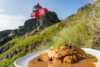
For some, it borders on heresy; for others, it’s a way to refresh tradition – why not try a modern twist on fårikål with chilli, garlic, ginger, and coriander? The method remains the same: layer Vesterålen lamb and cabbage, add aromatic spices in between, and finish with a sprinkle of coriander when serving. Perfect for warming up on a crisp autumn day.
Reindeer Gathering
Autumn is also the time for reindeer gathering. Sámi herders collect the herds in corrals for sorting, marking, and slaughter. In Sámi food traditions, the whole animal is used, and reindeer meat is among the most exclusive ingredients Norway has to offer. You can enjoy reindeer meat with a clear conscience – it is one of the healthiest meats available. Rich in vitamin B, iron, zinc, and selenium, it contains similar levels of some omega-3 fatty acids as cod and is as lean as chicken.
Fish
Skrei is the name given to the Norwegian Arctic cod stock that migrates every winter and spring to the Norwegian coast to spawn, creating a paradise for fishing and food enthusiasts in Vesterålen. Skrei mølje is a guaranteed favourite in Northern Norway, and internationally skrei is also a highly sought-after ingredient.
Halibut, salmon, and trout feature on many menus, but we also warmly recommend traditional boknafisk or the more modern grilled stockfish. Vesterålen is also home to a unique and perhaps even more exclusive fish – Arctic char. Norway’s oldest freshwater fish (present since the end of the last Ice Age) and the fish living furthest north. Today, Vesterålen is home to one of very few Arctic char producers, a quality-focused supplier of what is often called the queen of salmonids. With reddish flesh, firm texture, and mild flavour, Arctic char can be prepared in countless ways. In Vesterålen, it is enjoyed whole, as fillets, smoked, cured, fermented, and dried – grilled, pan-fried, boiled, and even as sushi and sashimi. It doesn’t hurt that it’s also rich in healthy mono- and polyunsaturated fats, as well as vitamins A, D, and B12.
Most of us associate crab, mussels, and other shellfish with sun and summer, but autumn is actually when these delicacies are at their very best. Nature’s pantry draws many people outdoors, but did you know the sea also offers an incredible vegetable garden? Seaweed and kelp are healthy and flavourful, especially rich in umami – the exciting fifth taste beloved by gourmet chefs (umami means “pleasant savoury taste” in Japanese).
Vegetables, Mushrooms, Berries, and Fruits
Few fruits survive in Arctic regions, but some do. Tart apples are perfect for cakes and cider. Plums thrive in sheltered, sun-warmed locations and can ripen as late as October. Some growers even cultivate pears and sweet cherries. Various cabbages, carrots, beets, and potatoes are also grown, and some farms offer pick-your-own harvests.
The almond potato (mandelpotet) is a delicacy widely used in Vesterålen, but if you’re lucky, you may find restaurants serving Gulløye – Northern Norway’s own heritage potato, cultivated in the region for more than a hundred years. Today, it is grown almost exclusively north of the Arctic Circle. Gulløye is the gourmet potato for true connoisseurs who know the importance of a great potato to a memorable meal.
The forest’s gold is the chanterelle, but porcini mushrooms are also highly prized. You’ll also find hedgehog mushrooms, both orange and pale varieties, among the safest edible mushrooms available.
Blueberries, lingonberries, wild raspberries, crowberries, rowan berries, and the queen herself – the cloudberry – appear in all their splendour throughout autumn, inviting wonderful foraging days in landscapes glowing with autumn colours. Did you know that a mix of blueberries and wild raspberries is called Queen’s Jam? Because of the flavour, of course. Try it!
Many restaurants make the most of autumn’s larder and showcase it in flavourful menus. Recommended dishes to look out for include Vesterålen lamb, reindeer, ptarmigan, moose, Arctic char, and halibut. And don’t forget the starter and dessert! Locally cured sausages, cheeses, lefse, cakes, and ice cream (have you tried brown cheese ice cream or caramel pudding made from goat’s milk?) help complete the culinary experience.
The Right to Harvest
In Norway, everyone has the right to access and use nature freely, regardless of land ownership. The main rules are set out in the Outdoor Recreation Act (Friluftsloven). The guiding principle is always to act with care and respect.
The Right of Public Access includes three key rights: the right of access, the right to stay, and the right to harvest.
All travel, use, and harvesting must be carried out considerately, with respect for nature, landowners, and other users.
Do not pick threatened species, and never remove all roots of a species in one area. The general rule is that if you have lawful access to an area, you may harvest what grows wild there, unless specific restrictions apply – which should be clearly stated on site.
The right to harvest applies in uncultivated land, public areas, and common land. In these areas, you may pick wild flowers, plants, berries, mushrooms, and roots of wild herbs, including for commercial use. Uncultivated land includes forests, forest plantations, mountains, rocky outcrops, scrubland, and wetlands. Cultivated land includes private gardens, farmland, meadows, and managed pasture.
In the counties of Nordland and Troms and Finnmark, special rules apply to cloudberries. However, it is permitted to pick cloudberries for consumption on the spot. Separate regulations also apply to seaweed and kelp. Wild nuts may only be picked for immediate consumption. Tapping sap requires permission from the landowner. The right to harvest does not necessarily apply to other natural materials such as moss, lichen, bark, branches, or trees. More information can be found in the Outdoor Recreation Act.
Some plants in nature are poisonous, ranging from mildly irritating to extremely dangerous and potentially fatal. Never pick plants unless you are absolutely certain they are safe to eat.
Foraging Safety Rules
- Only pick plants you know well and are absolutely sure are edible.
- Do not pick plants that may have been treated with pesticides or herbicides.
- Avoid foraging in areas exposed to pollution.
- Do not pick plants on cultivated land without permission – even if you mean well.
- Do not eat plants affected by disease or pests.
- When trying a new plant for the first time, eat only a small amount. Allergic reactions may occur.
- Do not pick endangered species (check the Norwegian Red List if unsure).
- Do not harvest everything from one spot – nature and wildlife need their share. Exceptions apply to invasive species.
- Do not pick plants in nature reserves or protected areas without checking local regulations.
- Show respect and care for nature – and enjoy the privilege of being able to use and harvest from it.